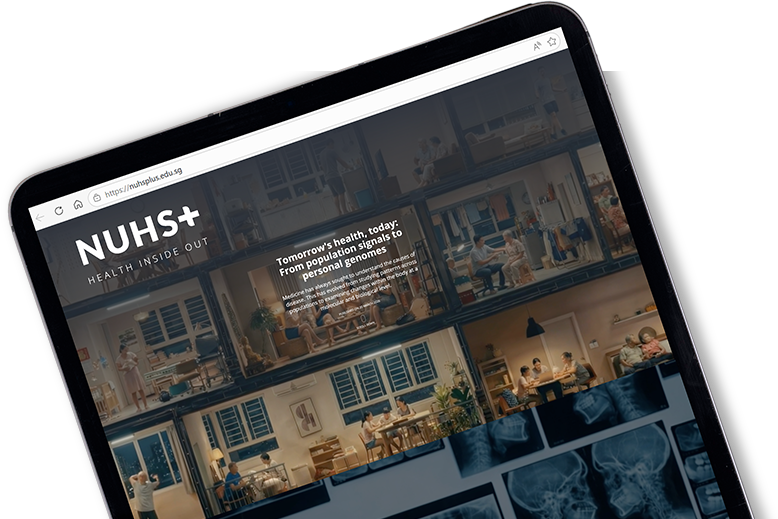
How precision health is transforming care
Published on 2 December 2025
As genomics and data-driven care become part of everyday clinical practice, clinicians such as Prof Tai E Shyong are helping shape how precision health is applied across the National University Health System.
Prof Tai E Shyong, a Senior Consultant in Endocrinology at the National University Hospital (NUH), also serves as the Chief Medical Officer of Precision Health Research, Singapore (PRECISE), which coordinates the National Precision Medicine Programme. Together with clinicians, scientists and public health teams, he has been helping to integrate genomics and data-driven approaches into routine care.
From treating illness to anticipating it
Across Singapore, doctors are increasingly using genetic and clinical data to detect risks earlier and to guide more targeted treatment. This shift from reactive to predictive and preventive care is part of the Healthier SG strategy, which seeks to reduce the burden from chronic diseases such as kidney disease, diabetes and heart disease.
Our genes play a role in determining our health risks, and they begin to act from the day we are born. The National Precision Medicine Programme aims to help healthcare systems and patients determine what is most important and best for them to optimise their health.
Prof Tai said these changes are now reflected in everyday practice at the National University Health System (NUHS). “Once we understand the underlying cause of a condition, we can take a more precise approach. It reduces uncertainty and helps families receive clearer answers much sooner.
“At NUHS, we are increasingly using genetics to determine which drugs are best suited to individual patients to minimise side effects and maximise benefits. NUHS is also leading a national effort to identify genetic causes of kidney disease so that early treatment can give our patients more healthy years living free of kidney failure,” Prof Tai added.
Turning scientific insight into better care
Trained in the United Kingdom and internationally recognised in endocrinology and human genetics, Prof Tai has spent much of his career studying how genetic variation contributes to diabetes and other associated disorders such as high cholesterol, obesity and high blood pressure. He has published more than 200 scientific papers and contributed to national clinical guidelines on diabetes and lipid disorders.
For him, progress in precision health represents a shared effort. Clinicians, researchers, genetic counsellors, public health teams, hospital systems and the Ministry of Health have worked in tandem to bring genomics into routine care.
“NUHS’ strength lies in the diversity of individuals within our health system which is closely integrated with a comprehensive university,” Prof Tai explained. “This allows us to bring a diversity of skills and talents to bear to solve problems.
“The collaboration enables us to introduce genomics into routine patient care in a safe and meaningful way, while developing new solutions for problems that are not readily solved.”
One of the clearest examples over the past several years: Thousands of patients have undergone pharmacogenetic testing. Every day, doctors are provided this information as they write prescriptions for their patients. It is about ensuring they have all the information they need to prescribe medications in a way that is safe and most effective for the patient.
Why precision health matters now
The value of precision health lies in the ability to understand disease risk earlier. Genetic information can reveal predispositions to conditions such as kidney or cardiac disorders, guide medication choices, and allow clinicians to intervene before complications develop.
NUHS has been laying the groundwork to support wider use of precision health. This includes ongoing work to enhance genomic testing capabilities, develop data systems, train healthcare teams, and ensure genetic information is used safely and responsibly.
Public trust remains a priority, as evidenced by ongoing work at the Centre for Biomedical Ethics. Hosted by the National University of Singapore (NUS), researchers at this centre explore such topical issues as the ethical use of gene-editing technologies, citizen engagement on precision medicine, and good governance for sharing health-related data.
Participation in genomic initiatives is voluntary, guided by digital informed consent and governed by strict privacy protections. In the future, some genomics initiatives will be easy to join — all it takes will be a few clicks on official health apps.
“Precision health must be equitable and accessible,” said Prof Tai. “Our responsibility is to ensure the system uses genetic information safely and in ways that benefit all patients.”
Preparing the health system for the decade ahead
The shift towards precision health has been unfolding across NUHS for several years. What was once considered the medicine of future has begun shaping real clinical decisions.
“We are moving towards healthcare that fits the individual — better prediction, earlier intervention and more precise treatment,” said Prof Tai.
As NUHS continues to embed genomics into clinical care, clinicians such as Prof Tai are helping to build a healthcare system that is more informed, more preventive and more personalised for Singaporeans.
In consultation with Prof Tai E Shyong, Senior Consultant, Division of Endocrinology, Department of Medicine, NUH.
Related Articles