A simpler way to test vision at NUH
Published on 9 January 2026
A compact, automated visual acuity testing device developed in-house is easing staff workload and giving patients a more consistent eye check.
At a glance
- A new automated visual acuity device developed at NUH frees up clinic space and streamlines workflow.
- The system lightens staff workload and improves consistency through automated scoring.
- Patients benefit from a more comfortable and efficient eye check.
At the National University Hospital’s (NUH) Eye Surgery Centre, the visual acuity test is an essential eye test that almost every patient must do. Traditionally, each test requires one staff member attending to a patient within a 3–4m testing lane. With rising patient volumes, these lanes become a bottleneck, as they demand space and manpower that clinics often cannot spare.
Enter the Automated Visual Acuity Test (AVAT) device, supported under the National University Health System (NUHS) Centre for Innovation in Healthcare (CIH) Practice Changing Innovations (PCI) Programme to address this workflow bottleneck. The aim was simple, according to Dr Rubin Yong, Research Fellow, National University of Singapore, Yong Loo Lin School of Medicine (NUS Medicine): to leverage technology to engineer a better way to do this test.
“At the NUH Eye Surgery Centre, the visual acuity test station is a significant bottleneck in the patient’s journey,” he said. “AVAT was developed to automate and streamline this process – improving throughput, reducing staff load and optimising space usage.”
The project began with A/Prof Victor Koh, Head and Senior Consultant, Department of Ophthalmology, NUH, and his team, and grew into a multidisciplinary effort. The development works were supported by grants from the NUS Summit Programme in Innovation (SPIN), Temasek Ecosperity and the National Health Innovation Centre (NHIC).
Rethinking an essential test
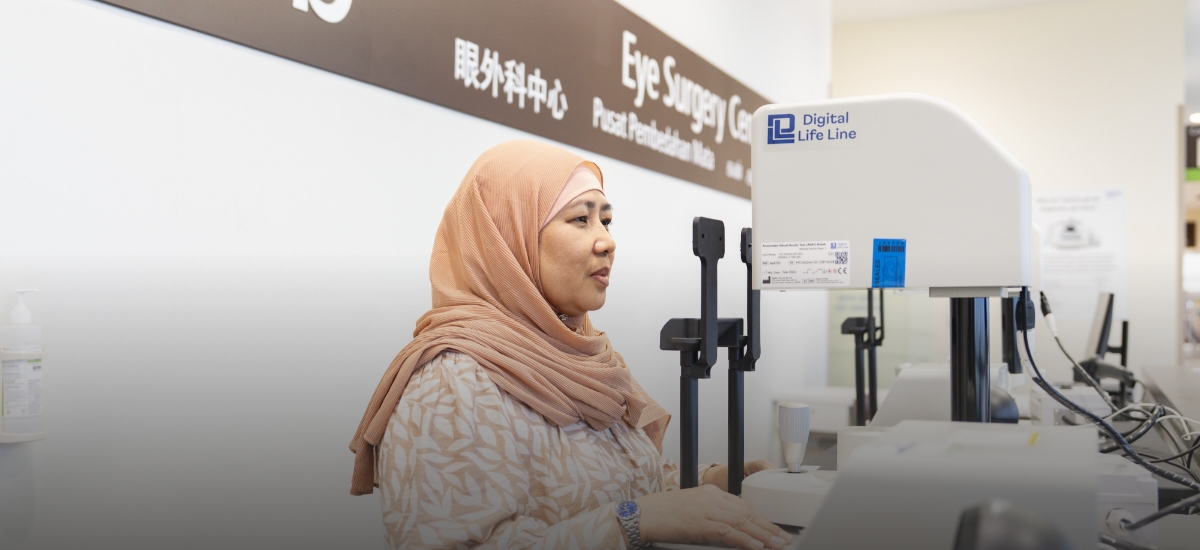
AVAT digitises the standard visual acuity check using a compact arrangement of lenses and mirrors so patients can test themselves. “It allows patients to do the test on their own, much like self-checkout kiosks in supermarkets and restaurants. This reduces the manpower required, and each unit occupies less space than a standard visual acuity lane,” said Dr Yong.
Instead of nurses giving repeated verbal instructions, supervising progress, and calculating scores, AVAT guides patients step by step on screen, adjusts the test based on their responses, and calculates the final score automatically. This reduces reliance on one-to-one staffing for visual acuity tests.
Nurses like Ms Sun Xuexia, Senior Staff Nurse II, and Ms Anisah Binte Abdul Rahman, Senior Enrolled Nurse I, from the Department of Ophthalmology at NUH, report practical gains.
“AVAT has changed our daily workflow, allowing us to focus more on what matters most – patient interaction and care quality,” Ms Sun said. “We are spending less time on manual calculations and chart management, and more time ensuring each patient receives personalised attention.”
In addition, AVAT has significantly reduced the space needed for visual acuity testing. While a traditional testing area previously measured about 3.5m by 1.8m (6.3m2), the AVAT device requires just 1.5m by 1m (1.5m2). This 4x reduction allows the clinic to redesign its space more strategically, rethinking patient flow and how resources are allocated across their facilities.
A patient survey conducted during the initial AVAT trial in 2023 also showed a positive response, with nearly 82 per cent of patients saying they preferred using the AVAT device, while 98.6 per cent said they would choose AVAT again at their next visit.
Improving accuracy and comfort
The system’s automated scoring and barcode results are scanned into the electronic health records, cutting transcription errors and saving administrative time that was previously spent manually keying in results. The testing environment is also more private and controlled, which many patients prefer.
“Once patients become familiar with the system, they complete tests more comfortably and efficiently than with traditional methods,” Ms Anisah explained. “This tends to suit younger patients and those used to digital interfaces.”
Consistency in testing has similarly improved. “AVAT’s standardised approach ensures every patient receives identical testing,” Ms Anisah added. “This consistency is invaluable for our confidence in tracking visual acuity changes over time and maintaining quality care across our entire team.
“With manual testing, results could vary depending on the staff member. Some might encourage patients to try reading more letters while others stop sooner. AVAT eliminates this variability by following the same protocol every time, ensuring reliable and comparable results that we can trust for patient care decisions.”
A smarter way forward
Dr Yong sees AVAT as an example of practical innovation for Singapore’s unique challenges: rising healthcare and manpower costs, limited land resources, and an ageing population. “By reducing both manpower and space requirements, AVAT proactively helps clinics operate more efficiently to cope with increasing eye care demand in a more sustainable manner,” he said.
AVAT can also be deployed outside the hospital. The device has already been trialled in schools, suggesting that it can support more frequent myopia screening in children and broader community deployment.
For the nurses, the experience has also changed how they view digital tools in healthcare. “Working with AVAT has reinforced my belief that healthcare technology works best when it enhances rather than replaces human care,” said Ms Sun. “Rather than distancing me from patients, it’s actually brought me closer to them.”
Dr Yong echoed this sentiment. “Bringing an innovation from a research idea into clinical deployment requires sustained collaboration across many groups, from clinical staff to engineers, researchers and administrators,” he said. “It is especially rewarding to see this innovation making a difference in the real-world patient care.”
What AVAT means for the future of eyecare
|

|
In consultation with Dr Rubin Yong, Research Fellow, NUS Medicine, as well as Ms Sun Xuexia, Senior Staff Nurse II, and Ms Anisah Binte Abdul Rahman, Senior Enrolled Nurse I, Department of Ophthalmology, NUH.
Related Articles