Autism and parenting: Connecting with your child on the spectrum
Published on 21 November 2024
These simple strategies can bring out the best in your young one and build a deeper connection.
Raising a child on the autism spectrum can feel like sailing into uncharted waters. You might often find yourself guessing or trying to decode your child’s behaviour, unsure of what they need or how to respond. At times, it may seem like you and your child are speaking different languages, with their world feeling out of reach.
But learning to understand your child’s unique needs can open new ways to connect, build stronger bonds and help them thrive. Every autistic child has his or her own needs, and the level of support required varies from child to child. When you take the time to observe and adapt to their cues, you can create a more supportive, connected environment where they feel understood.
So, what exactly is Autism Spectrum Disorder (ASD)? This neurodevelopmental disorder affects how individuals communicate and interact with others. In Singapore, between 20 to 25 per cent of 6,000 to 7,000 preschoolers assessed at KK Women’s and Children’s Hospital and National University Hospital (NUH) in 2023 showed signs of ASD.
“Compared to their typically developing peers, children on the autism spectrum may show less interest in interacting with others, have trouble paying attention to verbal and nonverbal cues during social interactions, and face difficulties relating to their family members and peers,” said Ms Zhang Guiyue, Senior Psychologist, Department of Paediatrics, NUH.
Some children may not be able to communicate with words, while others may speak but struggle to hold meaningful or appropriate conversation, she added.
Common challenges parents face

Understanding and supporting a child on the autism spectrum can be challenging. Here are a few hurdles that many parents encounter:
Recognising your child’s needs: Autistic children often face communication difficulties. Some may not speak at all, while others might express themselves in ways that are confusing to others. As Ms Lee Huijun, Senior Speech Therapist, Department of Paediatrics, NUH, said, “Parents of autistic children often struggle to understand what their child wants or needs. They might have to guess to figure it out.”
Grabbing and keeping attention: Children on the autism spectrum may not always respond when you try to engage with them, making it difficult to sustain their interest in activities. They may also struggle with observing and copying behaviours, which is a big part of how children learn. This can make daily routines or teaching new skills more challenging.
Building relationships: Some children may show little interest in interacting with people, preferring to focus more on specific objects or topics. This can be frustrating for parents who are trying to build a closer bond with their child.
Managing behaviours: Without the ability to express their feelings with words, some children on the autism spectrum may communicate their feelings through crying, screaming or even hurting themselves and/or others. Public meltdowns can be particularly stressful for parents.
Supporting social learning and communication
The good news is that with the right support and early intervention, many children on the autism spectrum can make significant strides in their communication and social skills.
“Starting intervention early helps children learn and achieve essential milestones and life skills from the start,” said Ms Chiang Jing Jing, Senior Occupational Therapist, Department of Paediatrics, NUH. “The training may also equip parents with skills and strategies to support their children effectively.”
Research shows that early interventions – starting from as young as age two – can lead to lasting improvements in a child’s development, particularly in areas like communication and intellectual abilities.
At NUH’s Child Development Unit, therapists use methods like the Early Start Denver Model to support children on the autism spectrum in building social and communication skills. These interactions – through which the children notice how people behave, speak and express themselves through words and facial expressions – are essential in developing language and social growth.
“Through engaging their child in fun and enjoyable play and daily routine activities, parents teach important communication, social interaction and play skills,” said Ms Chiang.
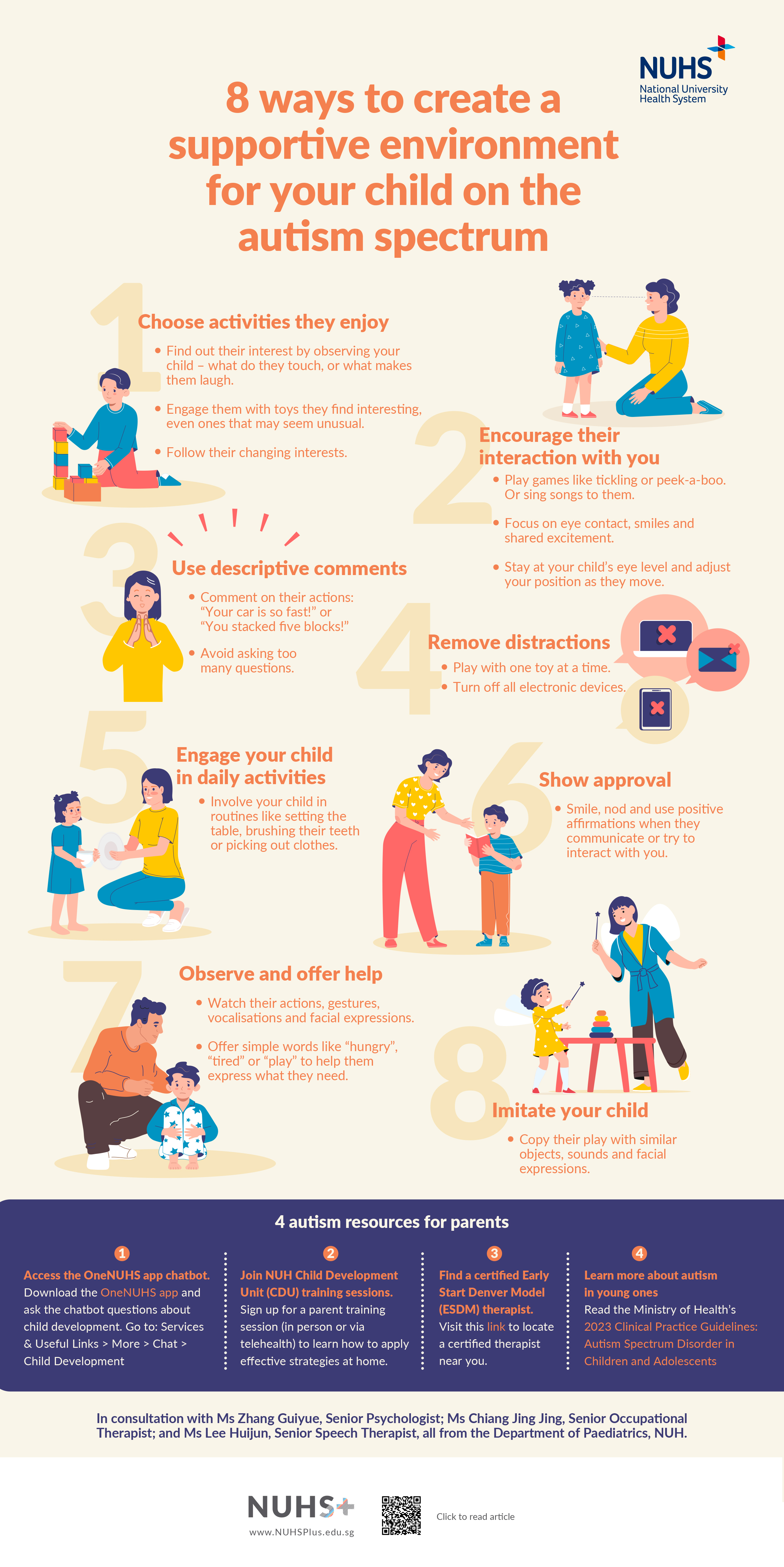
In consultation with Ms Zhang Guiyue, Senior Psychologist; Ms Chiang Jing Jing, Senior Occupational Therapist; and Ms Lee Huijun, Senior Speech Therapist, all from the Department of Paediatrics, NUH.
Related Articles