Making patient updates clearer for families
Published on 15 July 2026
For families whose loved ones are in hospital, regular updates from the medical team often bring reassurance. JCH pilots secure delivery of updates to reduce missed or delayed communication.
At a glance
- JCH is piloting DISCUSS, a new approach that separates urgent calls from routine updates
- Routine phone updates can be time‑consuming, especially when calls are missed or repeated
- The new workflow allows non‑urgent updates to be delivered more consistently and flexibly
For families anticipating updates on their loved one, missing a call from the care team can be frustrating, and results in further waiting for the next correspondence.
In post-acute care at Jurong Community Hospital (JCH), recovery may span weeks. During this time, families depend on regular updates to understand how their loved ones are progressing.
Updates via calls are often missed, delayed or delivered at inconvenient times, particularly when they are not urgent.
Bridging the gap in long-term recovery
For families, an adequate understanding of their loved one’s recovery progress often depends on updates that arrive at the right time and with the right context.
In practice, these updates can be difficult to coordinate. Each call may involve repeated attempts, identity verification and documentation, and is often fitted in between ward rounds and other clinical duties.
“For caregivers, it is not just about receiving updates,” said Dr Lee Chunxi, Principal Resident Physician in Post‑Acute and Continuing Care at JCH. “They are trying to understand how recovery is progressing over time.”
“When conversations happen across separate calls, information can feel fragmented. We often have to repeat to help families make sense of it,” she added.
Dr Yam Kai Feng, Consultant in Post‑Acute and Continuing Care at JCH, said the challenge was often logistical.
“Calls rarely happen in one attempt,” he said. “By the time we reach the right person and document what was discussed, the process can take longer than the update itself.”
“When a loved one is unwell in hospital, the experience is already difficult. We should find ways to make updates clearer and less distressing for families,” he added.
Rethinking how updates are delivered
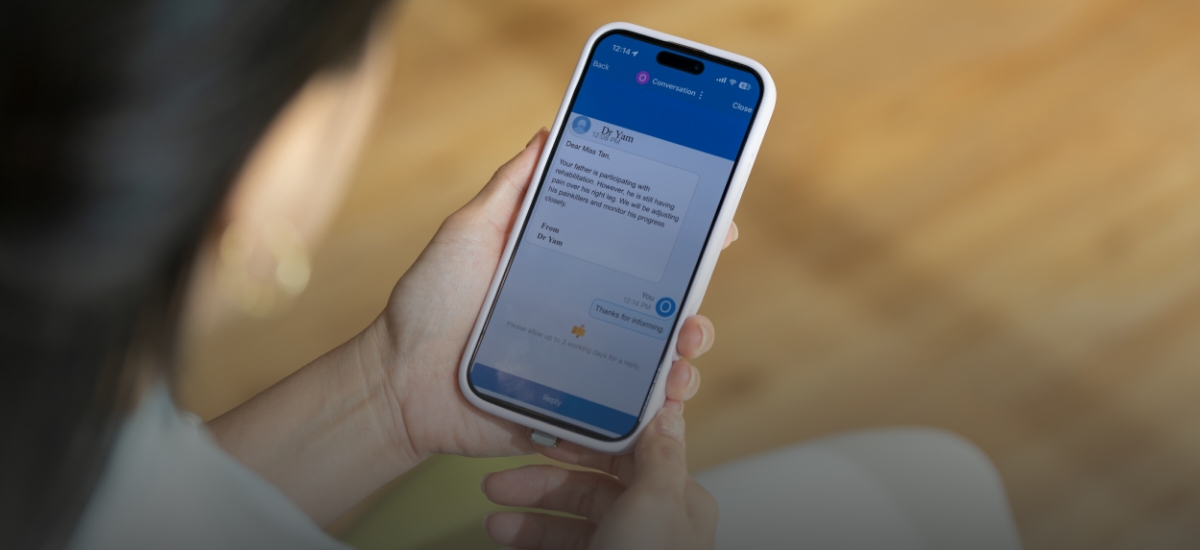
To address these gaps, JCH is piloting DISCUSS (Dynamic Secure Credentials‑verified Communication Software), a new approach to delivering routine updates.
Instead of relying on repeated calls, the system allows non‑urgent updates to be shared through secure messages that families can access at their convenience.
The issue at hand relates not only to how often updates are delivered, but whether they align with how families receive and manage information today.
It introduces a workflow where communication is triaged by urgency. Urgent or time‑sensitive matters continue to be handled through phone calls, while routine, non‑urgent updates are sent through secure messages that families can read and respond to at their convenience.
“It is not about replacing calls,” Dr Lee said. “It is about being more deliberate about when a call is needed, and when it is not.”
Access is verified through Singpass, and each interaction is recorded within the patients' electronic medical records, reducing the need for repeated verification and separate documentation.
From time‑bound calls to flexible delivery
In the current model, updates often require coordination between clinician availability and family schedules.
With DISCUSS, routine updates can be shared without the need to align both, allowing calls to be reserved for situations that require immediate attention.
“By separating urgent calls from routine updates, we can focus time and effort for calls on situations that require immediate attention,” Dr Yam said.
Building continuity across recovery
The platform supports routine touchpoints such as admission updates, multidisciplinary reviews and discharge planning.
For Dr Lee, the value of DISCUSS lies in continuity.
“It creates a clearer thread of communication,” she said. “Families can revisit earlier updates rather than relying on memory from separate conversations.”
This also improves consistency across care teams, allowing doctors, nurses, pharmacists, allied health and medical social services to contribute to a shared view of the patient’s progress.
Refining how communication fits with care
Currently piloted in selected wards at JCH, DISCUSS is expected to expand in phases, with potential use in other care settings such as chronic disease management and geriatric care.
The aim is not to replace conversations, but to reshape how routine communication fits into care.
For healthcare teams, it means fewer missed calls and clearer communication. For families, it means fewer gaps between what is happening and what they understand, during a difficult and uncertain time.
As the pilot progresses, the focus is not only on how often updates are provided, but on how well they help families keep track of their loved one’s recovery over time.

|
In consultation with Dr Yam Kai Feng, Consultant, Post-Acute & Continuing Care, JCH; and Dr Lee Chunxi, Principal Resident Physician, Post-Acute & Continuing Care, JCH.