IntelliRounds: Smarter patient prioritisation for ward rounds
PUBLISHED ON
SCROLL DOWN
Every morning, junior doctors arrive early before ward rounds begin to manually triage patients.
They review long patient lists, scanning vital signs, laboratory results, nursing notes and overnight events scattered across the Electronic Medical Record (EMR), then summarise it all so the team can decide who to see and in what order.
With a caseload of 20 to 30 patients per team, this daily process is slow, repetitive and increases the risk of overlooking crucial information.
“Manual triage is cognitively heavy, inconsistent and time-consuming, especially with 20 to 30 patients per team,” said Dr Clara Ngoh, Senior Consultant, Division of Nephrology, Department of Medicine, National University Hospital (NUH). “It relies on fragmented data across different systems and on variable clinician experience, which increases the risk of missed deterioration.”
At the National University Health System (NUHS), an in-house artificial intelligence (AI) tool called IntelliRounds is beginning to transform these challenges — by rethinking how ward rounds begin.
Starting the day with clarity, rather than clutter
On a busy ward, the day often involves multiple rounds, each requiring someone to piece together a complex and fragmented clinical picture. Clinical information sits in different parts of the EMR, and bringing it together takes significant time and effort before any decision can be made.
“Most mornings, we come in early just to prepare. We review patient lists and do our own pre-rounds before seeing patients. After that, we go on another round with the registrar. Later, the full consultant round happens again,” said Dr Trisha Seet, Resident, NUHS.
“A lot of our time goes into finding and summarising information rather than acting on it. We were pulling data from different places just to get a complete picture.”
Long patient lists make it even harder to identify urgent cases. Reviewing patients in sequence means a patient who has quietly deteriorated overnight may only be seen later.
The result is a process that consumes hours of clinicians’ time, yet does not always direct that time to the patients who need it most.
An overnight pre-round synthesis that does the heavy lifting
IntelliRounds automates this overnight pre-round synthesis, taking over the manual collation that once fell to junior doctors.
Working in the background before the team assembles, it draws together vital signs, National Early Warning Score (NEWS) metrics, laboratory investigations and medication lists, alongside clinical notes, to build a complete overview of each patient.
From this, the system produces patient-level summaries, detects overnight changes and generates prioritisation signals — distilling key information into something the team can act on at a glance.
It is, Dr Ngoh said, a first of its kind locally. “IntelliRounds is the first clinically live, AI-powered ward-round prioritisation and synthesis system in Singapore to be deployed in real-world inpatient medicine wards, with formal safety tracking, clinician-in-the-loop validation and workflow redesign,” she said.
“While other tools tend to focus on documentation or isolated decision support, IntelliRounds holistically integrates overnight synthesis, prioritisation and workflow orchestration together for ward rounds.”
The payoff is measurable. During a recent pilot at Ng Teng Fong General Hospital (NTFGH), time-motion studies showed roughly 60 to 90 minutes of manual pre-round preparation eliminated per team each day without compromising safety. This enables junior clinicians to be redeployed to other areas where clinical support is most needed.
“This shifts the daily focus from rounding everyone in sequence to seeing the right patients first, for the right reasons.”
— Dr Clara Ngoh
Seeing the right patients first
The IntelliRounds pre-round tool filters and ranks patients based on criteria such as clinical deterioration signals, unstable trends, and those who are newly admitted or ready to be discharged.
Patients are then tiered by acuity, allowing for earlier intervention and meaningful prioritisation.
“Acuity tiering surfaces unwell patients before rounds even begin, which enables earlier intervention and reduces reliance on last-minute bedside discovery,” Dr Ngoh said.
Junior doctors can safely skip pre-rounds on stable patients and focus on those who are unwell or ready to go home, while senior doctors can plan a round that prioritises potential discharges and deteriorating patients.
It also gives clinicians more time for meaningful conversations with patients and families.
A case from the NTFGH pilot shows how this plays out. A patient was admitted overnight for acute asthma exacerbation.
IntelliRounds flagged and prioritised the patient, recognising set parameters of a new admission and significant clinical deterioration, prompting the pre-rounding medical officer to prioritise the case early that morning. That led to earlier senior review and timely adjustment of the patient’s nebulisation frequency to manage symptoms.
Across all stages of the pilot, no major safety incidents were recorded. “It allows leaner teams to keep functioning safely, by concentrating medical attention where it matters most,” Dr Ngoh said.
There are plans in the pipeline to integrate advance care plans and code status documentation to provide context to acuity signals, ensuring treatment decisions align with patient preferences.
“During critical moments, having that information immediately visible ensures escalation, ceilings of care and treatment intent are clear to the team, supporting timely, appropriate decisions that are aligned with the patient’s wishes.”
— Dr Clara Ngoh
Redesigning the round, not just the data
The biggest takeaway from the pilot, Dr Ngoh said, is that better data is not enough on its own. “Even a highly accurate and safe AI system will have limited real-world impact if it is inserted into unchanged clinical workflows,” she said.
Workflow redesign is key to ensuring the technology achieves its intended impact, through actionable and timely alerts that are aligned to the roles junior clinicians, registrars and consultants play.
The longer-term “dream state” goes further: an optimised ward round team configuration, with the entire team rounding together, supported by IntelliRounds insights.
Reaching that point, Dr Ngoh said, requires “decoupling information synthesis from physical presence” — enabling IntelliRounds to prepare a shared dashboard so the team no longer has to gather information in person before they can begin.
“Rounds can then start with shared situational awareness and better prioritisation, rather than time spent simply gathering information.”
Trust is built the same way it did with earlier NUHS tools: through senior clinician involvement, transparent AI reasoning, clear safety guardrails and hands-on pilots with rapid feedback. “Teams initially adopt IntelliRounds as a thinking partner,” Dr Ngoh said, “Confidence increases as its accuracy and fit with the workflow are demonstrated.”
“Without this redesign, AI risks becoming just another dashboard, rather than a tool that shapes decisions.”
— Dr Clara Ngoh
From pilot to wider scale
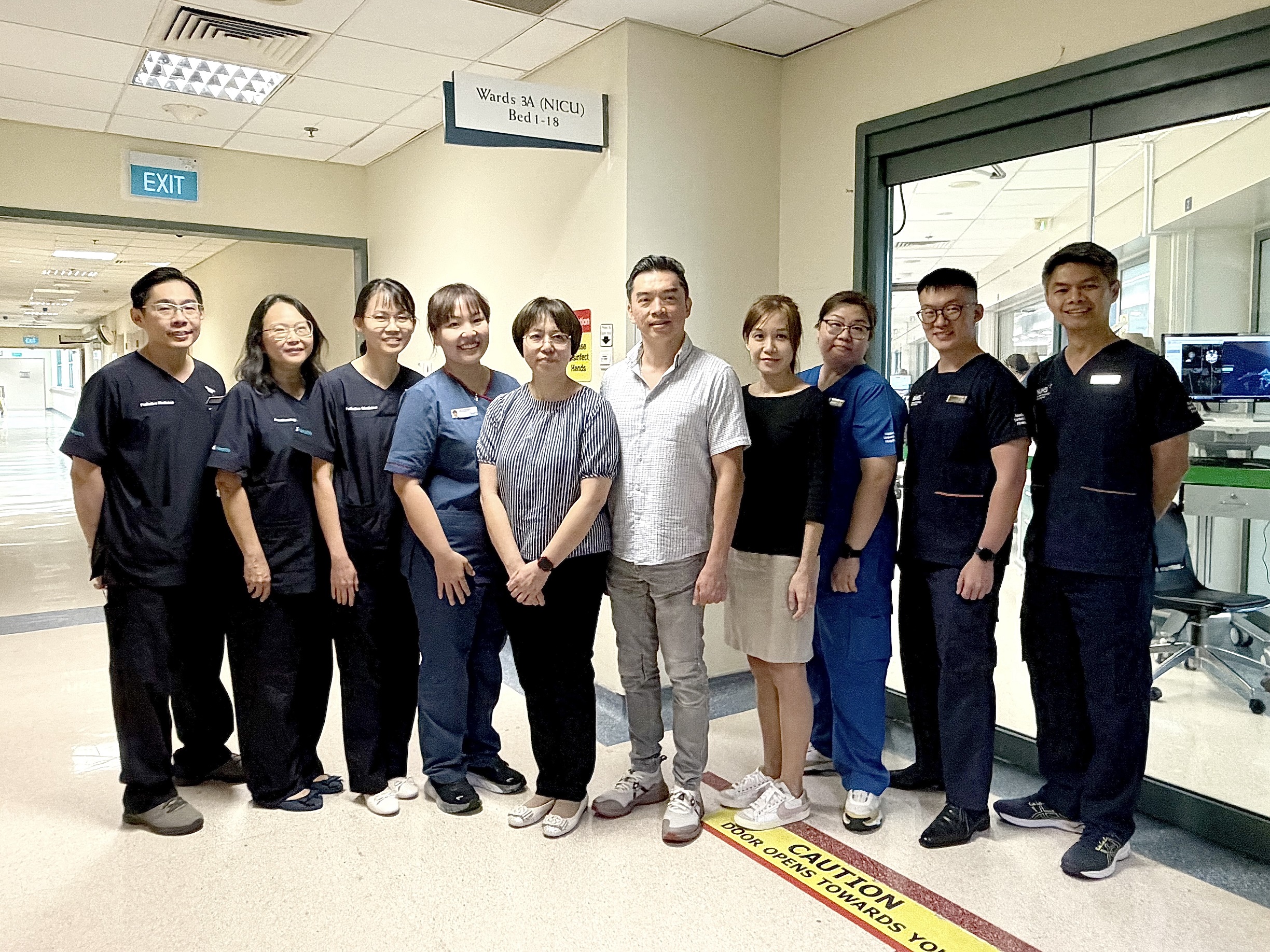
Lessons from the NTFGH pilot will directly inform the design of the next pilots in selected inpatient wards at the National University Hospital (NUH) and Alexandra Hospital (AH), where further rigorous testing will be done to see how AI-generated insights can fit safely into real clinical workflows.
At the same time, IntelliRounds is also being built to ease pressure beyond the ward round. In the near future, it can identify patients suitable for the NUHS@Home programme early in their admission, flagging those with improving trajectories, stable vitals and low acuity, who may be ready for supported discharge.
“Earlier identification enables proactive discharge planning, smoother transitions of care, shorter stays and better use of beds,” Dr Ngoh said, easing demand on a finite number of hospital beds.
Beyond rounding priority and NUHS@Home suitability, the team is exploring discharge bundling, write-back of structured notes, integration with platforms such as Microsoft Teams and Epic, specialty-specific modules, and broader synthesis to support cross-coverage and handover.
As IntelliRounds evolves from a morning triage tool into a comprehensive clinical copilot, it aims to fundamentally reshape the inpatient journey, ensuring that every minute of clinician time and every hospital bed is directed exactly where it matters most.

|
In consultation with Dr Clara Ngoh, Senior Consultant, Division of Nephrology, Department of Medicine, National University Hospital (NUH).